Camera Thrift Finds in Huizen
One of the many things I like about Dutch culture is how much Dutch people love their second-hand shops and flea markets. A few years back I started poking around a couple of these places in Amsterdam. What stuck with me then wasn’t the bargains. A good Dutch thrift store, the warehouse kind, is less a shop than a museum where every exhibit has a price tag and nobody minds if you touch it. It’s the one set of Amsterdam windows where the rule runs the other way around. You walk in and there’s the domestic life of the 1940s through the 1980s, sorted into loose thematic heaps: radios, enamelware, typewriters, the odd bit of taxidermy, and, for contrast, a € 500 floor lamp by some Danish industrial designer. That’s what I go for, the amateur-ethnographer feeling of stepping back a few decades in a room you’re allowed to rummage through. Whatever I carry out is a side effect.

I’d heard good things about the thrift-store chain Kringloop Kleurrijk (in Dutch, “kringloop” means “thrift store” and “kleurrijk” means “colorful”), and I had a free time over the weekend, so I went in without any great expectations. Oh boy, what a surprise was waiting for me there. Usually these places take some walking to turn up anything interesting, since the good stuff is scattered everywhere. This time I spotted it almost immediately: a glass cabinet full of photography gear. The good stuff at these places always lives behind glass, as if a 45-year-old lens might otherwise make a break for the door. I asked an employee to unlock it so I could get a closer look at the lenses and everything else in there.
The First Find
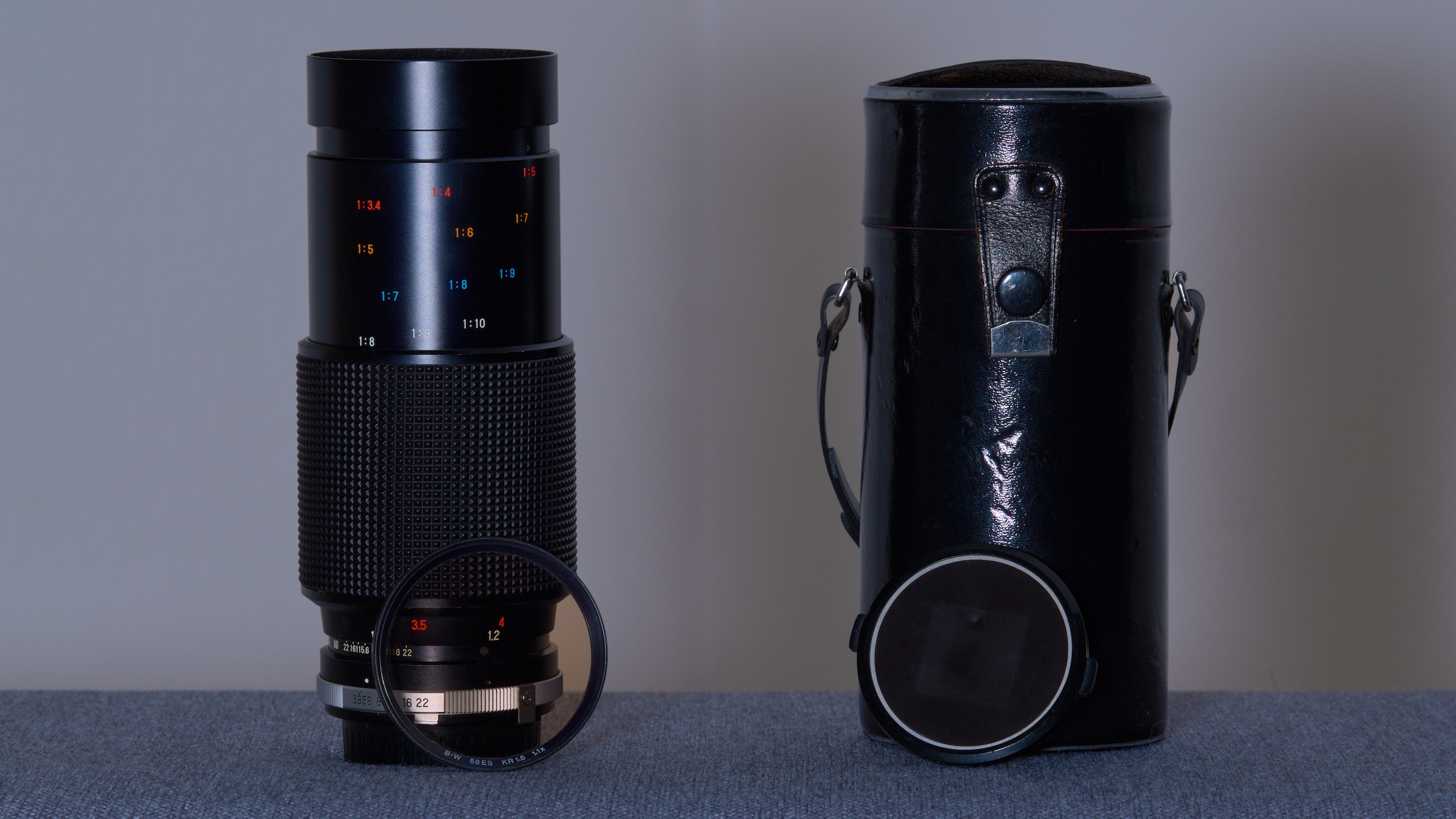
The first thing I noticed was a glossy black cylindrical case. Inside was hiding a Panagor PMC Auto Tele Zoom 3.8/80–200. Panagor was never really a manufacturer, just a badge, one of the independent importers (alongside names like Soligor and Rokunar) that bought lenses from Japanese factories and had their own name engraved on the ring. In Panagor’s case the factory was Kino, the name behind the well-regarded Kiron lenses. Somewhere in Japan, one factory built this exact lens under something like 40 names, blissfully unaware that half a century later people be arguing over which badge was secretly best. This one is a constant-aperture manual-focus telephoto from around 1980, a one-touch push-pull design where the same ring both focuses and zooms, in Minolta MD mount. It’s not a legend, just a competent budget tele, sharp once stopped down and perfectly pleasant wide open (as many of them are). And it had arrived wearing a decent hat: a B+W 58 ES KR 1,5 skylight filter, the mildest warming filter B+W makes, German glass from the Schneider-Kreuznach family. On film it does real work, warming the blue cast you get in open shade. On a digital body the white balance mostly cancels that out, so there it just earns its keep as good protective glass. This is the kind of filter people defend in 500-word forum posts. For € 27,50, case and filter included, I was not about to argue with the math.
- Panagor PMC Auto Tele Zoom 3.8/80–200
- Filter B+W 58 ES KR 1,5 1.1×
- Lens case
The Second Find
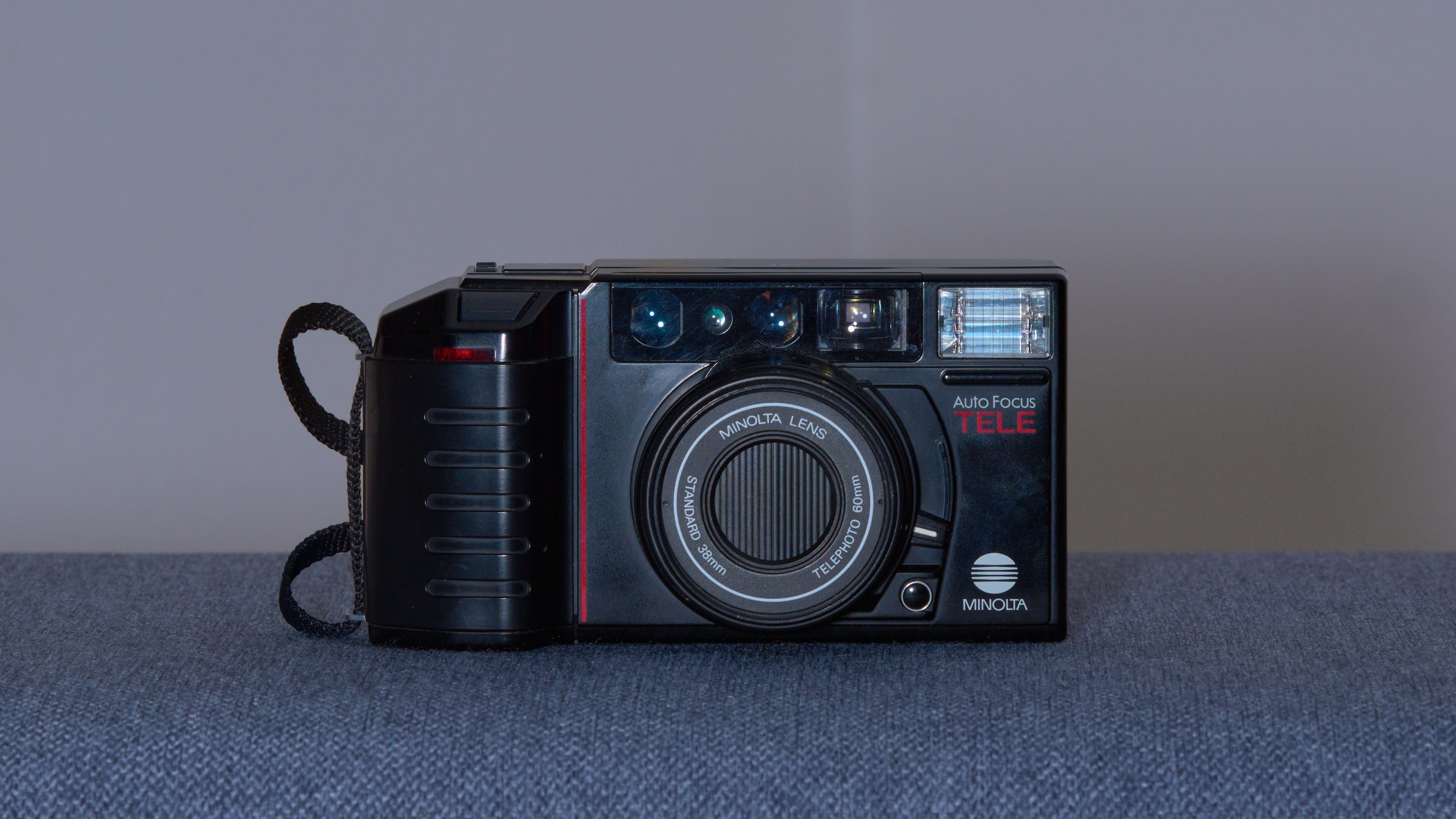
The next thing I noticed was a Minolta AF-Tele, an early electronic point-and-shoot from the mid-1980s. Its party trick is a lens that switches between 38mm and 60mm, a jump that is, mathematically, barely a gesture. But in 1985 it was basically a spaceship. These were among the first genuinely competent autofocus compacts, and the whole breed has quietly appreciated since: a clean working one now tends to out-price plenty of the proper SLRs from its own decade on the used market, which says more about point-and-shoot nostalgia than it does about the SLRs. This one still had a live battery in it, too. When I opened the film door and closed it again, it cheerfully wound on to the first frame, decades later, as if nothing had happened. This lot was € 32,50.
The Final Boss
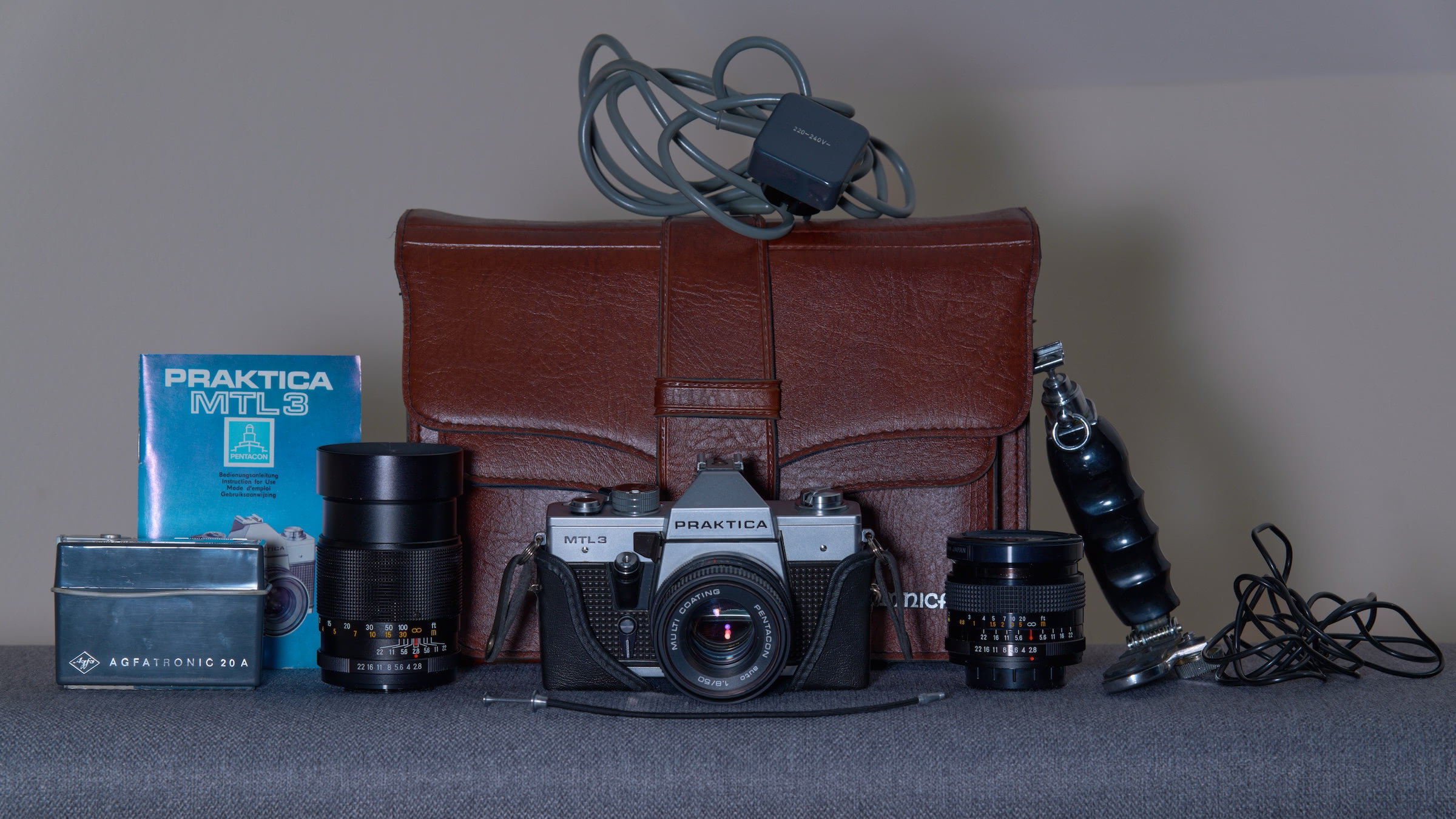
But the real prize was a brown leather camera bag. Inside was a complete photographer’s kit in near-untouched condition: the East German Praktica MTL3, built in Dresden by the Kombinat Pentacon, three lenses at different focal lengths (Kenlock 2.8/28, Pentacon 1.8/50, Kenlock 2.8/135), an Agfatronic 20 A flash with its European power cord, a Japanese Velbon flash bracket grip, a handful of rubber hoods, adapters, flash sync cables, and even the MTL3 manual in German, English, Dutch (yay), and French. I checked the mirror, ran through the shutter speeds, confirmed the meter still responded, and looked the glass over. Everything worked, and worked well. This is roughly the point where a Japanese eBay seller reaches for “MINT+++”: light signs of use, no damage, no scratches, no fungus. The plus signs are load-bearing: MINT means good, MINT+ means very good, and MINT+++ means the seller would like you to pay for the punctuation. The price tag for everything all together was almost insultingly low: € 65,50.
- Praktica MTL3
- Pentacon Auto 1.8/50
- Kenlock-Mc.tor MC 2.8/28
- Kenlock Automatic MC 2.8/135
- Agfatronic 20 A + power cord
- Velbon flash bracket grip
- Shutter release cable
- Leather camera bag
- Leather half-case
- Various small accessories
Aftertaste
Somebody had cleared out a grandfather’s 1980s photography kit: every rubber hood matched to a lens, the sync cables coiled, nothing rattling loose, nothing missing. It had plainly spent its life being looked after, and then at some point stopped being needed. Maybe the owner upgraded and left it in a closet. Maybe they passed, and whoever emptied the house saw a heavy bag of metal and glass and no reason to keep it. Either way, someone spent years choosing these pieces, learning them, keeping the manuals, and the whole careful little system outlasted their interest in it, or outlasted them. That’s the part of thrifting I can never quite be cynical about. It’s a little bit sad. But it’s also the only reason any of it is still here, handed from someone who was finished with it to someone who’s only just starting. Which is, more or less, what the shop’s name promised: “kringloop”, the Dutch word for a thrift store, literally means “recirculation”, the loop a thing travels as it passes from one set of hands to the next. I’m glad it ended up in my hands instead of a landfill. I’d like to think the original owner would be glad someone’s using it.
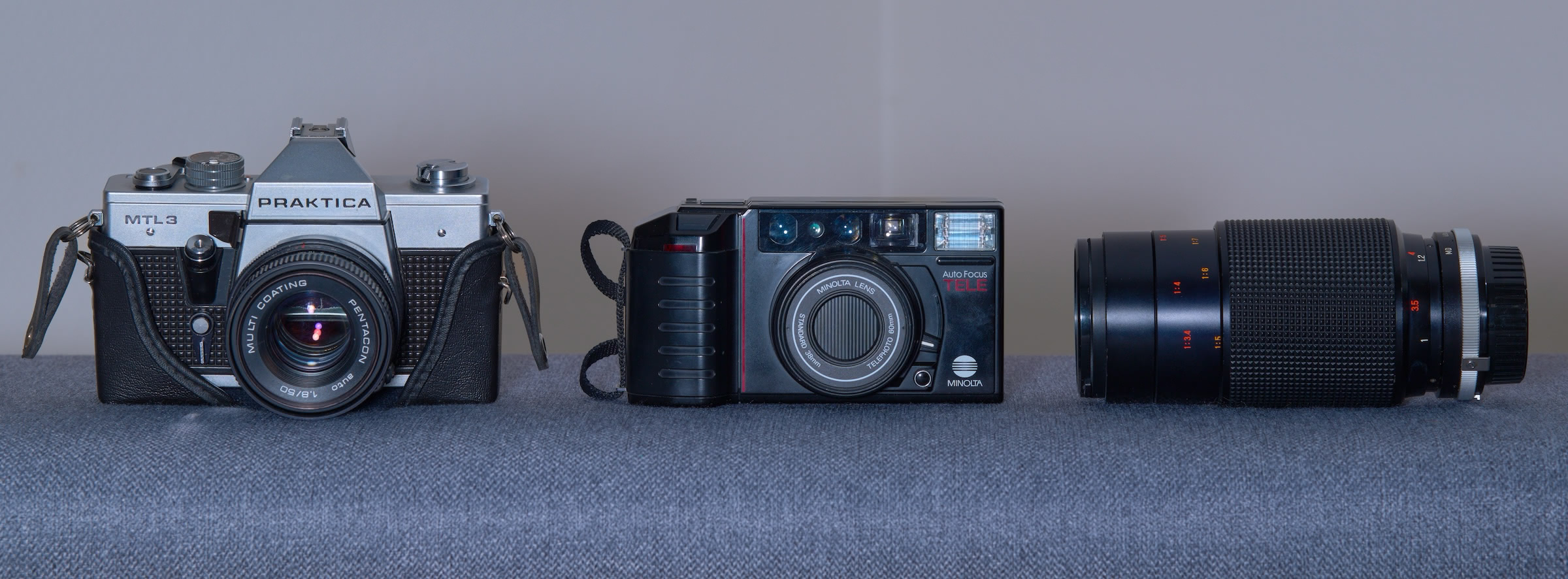
And that’s really what this was for me: a beginner’s windfall. I’ve shot very little film so far, and to anyone who’s been at it for years, a rebadged zoom, a plastic autofocus compact, and a budget East German SLR probably add up to a shrug. This bag contains more competence than I currently possess. For me, they’re a whole starter kit for almost nothing, three or four different ways into film at once: a fully manual SLR that makes you weigh every setting, an autofocus compact that does the weighing for you, a long zoom, a fast normal, a wide.
So I paid up, stuffed everything into my backpack, which took some doing since I already had a camera and 2 lenses on me, and went back home standing on the pedals, backpack full of another family’s memories and a genuinely alarming amount of metal. That evening I started hunting down the manuals to read on my iPad. This is how it begins. One brown leather bag, and by midnight you’re three tabs deep learning what a mercury cell is and why yours is now illegal in the EU.
Whatever I manage to shoot with all of this will probably end up here eventually, assuming the film comes back with anything on it. If you don’t want to miss it, you can subscribe to my Journal and let it find you.